Freedom of scientific research
“The arts and scientific research shall be free of constraint. Academic freedom shall be respected.” Art. 13 [Freedom of the arts and sciences], EU Charter of Fundamental Rights, https://
fra .europa .eu /en /eu -charter /article /13 -freedom -arts -and -sciences “Arts and sciences, research and teaching shall be free.” Art. 5 [Freedom of expression, arts and sciences], Basic Law for the Federal Republic of Germany. https://
www .gesetze -im -internet .de /englisch _gg /englisch _gg .html Art. 8, EU Charter of Fundamental Rights, https://
fra .europa .eu /en /eu -charter /article /13 -freedom -arts -and -sciences: “Protection of personal data
Everyone has the right to the protection of personal data concerning him or her.
Such data must be processed fairly for specified purposes and on the basis of the consent of the person concerned or some other legitimate basis laid down by law. Everyone has the right of access to data which has been collected concerning him or her, and the right to have it rectified.
Compliance with these rules shall be subject to control by an independent authority.”
Art. 27, Universal Declaration of Human Rights, https://
www .un .org /en /about -us /universal -declaration -of -human -rights: “Everyone has the right to the protection of the moral and material interests resulting from any scientific, literary or artistic production of which he is the author.”
The duality of good research
It is not uncommon to introduce safe and secure AI systems through the lenses of ethics and law Enrico Glerean, 2025.
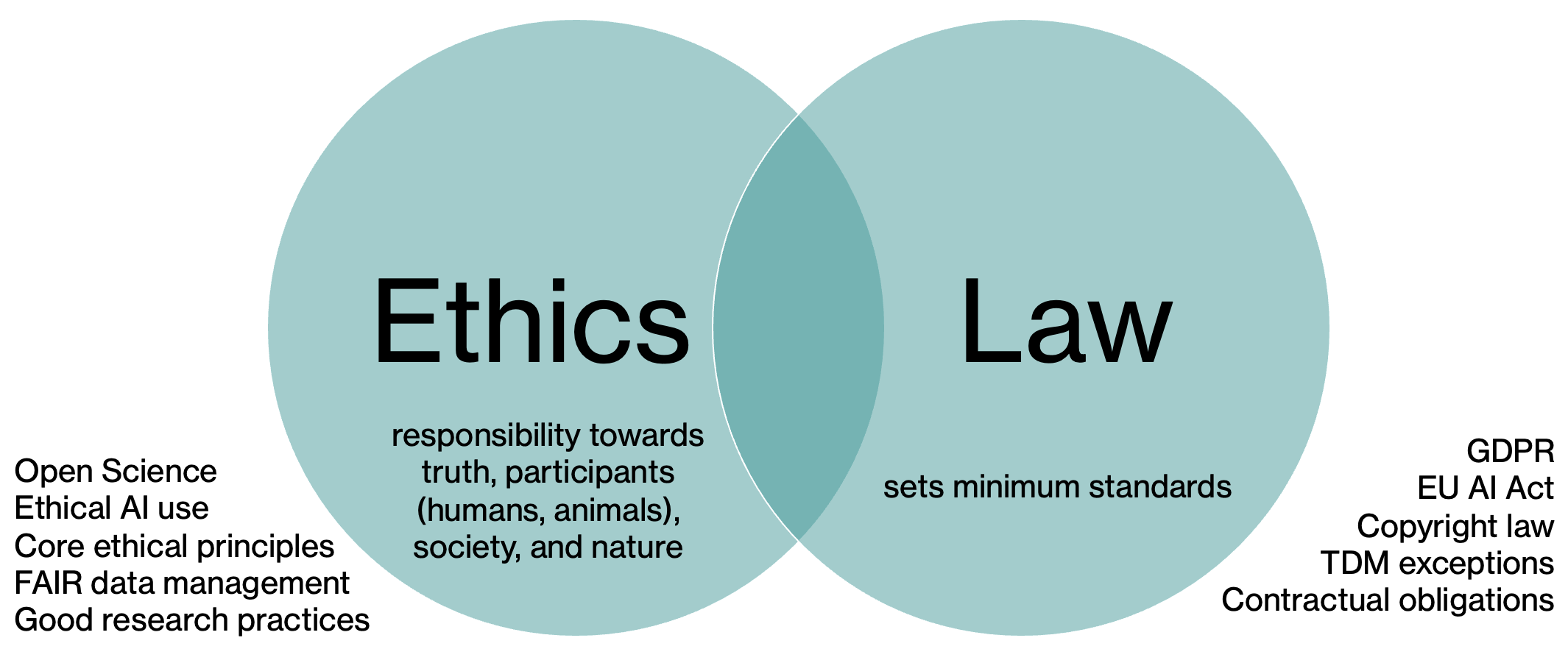
In context of research ethics means responsibility towards truth, participants (humans, animals), society, and nature. It includes Open Science, Ethical AI use, core ethical principles, FAIR data management, and good research practices.
In contrast to ethics, law sets minimum standards. It includes GDPR, EU AI Act, Copyright law, TDM exceptions, contractual obligations, etc.
The trinity of good research
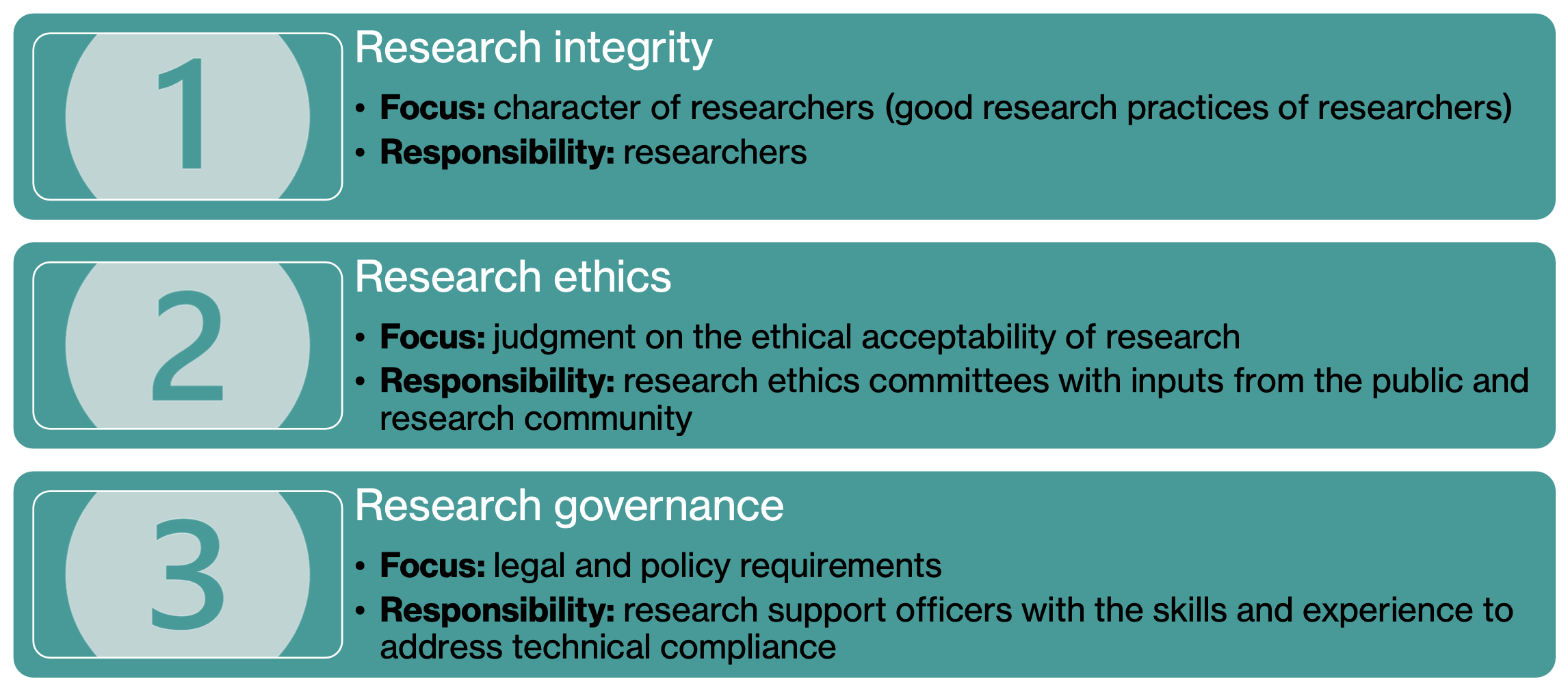
The trinity of good research was introduced by Kolstoe & Pugh (2024). They gave clear definitions of research ethics, research integrity, and research governance. They differ in their focus and corresponding responsibilities.
While research integrity focuses on responsibility towards truth and researcher’s behaviour, research ethics deals with responsibility towards participants, society, and the environment.
Too many values, principles, laws, regulations...
Researchers face variety of (partially contradicting) values, principles, codes of conduct, guidelines of good practices, ethics frameworks, laws, regulations, institutional policies, funder requirements, contractual obligations, disciplinary norms, open science mandates, data protection rules, security requirements, journal data and AI policies.
It feels impossible to navigate.
Pragmatic approach: Remember responsibilities
To conduct responsible high-quality research, researchers need supporting infrastructure. Research organizations are responsible for providing infrastructure, legal certainty, ethical oversight, data protection, and secure environments. Researchers are supported by ethics committees, ombudspersons, research data management teams, legal & data protection offices, IT security teams, Open Science offices, export control offices, etc.
Research ethics
Should we do this project? Values, principles, social responsibility, impact on humans, animals, society, and nature. GET ethical approval from research ethics committees for your research project.
Research integrity
How should we behave? Responsibility, honesty, rigor, transparency, FAIR & Open Science, following good research practices, avoiding questionable research practices & scientific misconduct. ACT responsibly and honest.
Research governance
What must we comply with? Laws (GDPR, copyright, EU AI Act), policies, funding rules, contracts, licenses, and agreements. GET help from research support units for your research project.
Pragmatic approach: Remember the goal
Research ethics, research integrity, and research governance are not constraints but foundations for excellent research. If we agree on that, compliance becomes a quality tool, not paperwork.
- Enrico Glerean. (2025). Fundamentals of Secure AI Systems with Personal Data [Training curriculum on AI and data protection]. https://www.edpb.europa.eu/system/files/2025-06/spe-training-on-ai-and-data-protection-technical_en.pdf
- Kolstoe, S. E., & Pugh, J. (2024). The trinity of good research: Distinguishing between research integrity, ethics, and governance. Accountability in Research, 31(8), 1222–1241. 10.1080/08989621.2023.2239712